AI TOOL / #02811
Bytebot
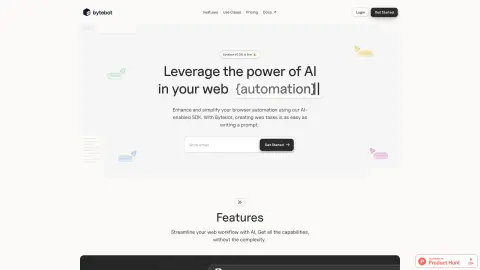
Bytebot uses natural language processing and AI to simplify the process of web scraping and automation.
Introduction
Bytebot simplifies web scraping and automation using natural language prompts and AI.
What is Bytebot?
Bytebot simplifies and optimizes web scraping and automation processes—from data extraction to form filling—by converting natural language commands into complex browser actions. It offers AI-powered features that streamline web workflow tasks, eliminating unnecessary complexity. Bytebot represents a one-stop solution for developers looking to build desktop proxies.
How to use Bytebot?
Use natural language commands to instruct Bytebot to perform web scraping and automated tasks, such as data extraction and form filling.
The core functions of Bytebot
Conversion of natural language into browser-compatible format
Web scraping
Web page automation
data extraction
Fill out the form
Desktop proxy construction
Related
NightClub: Drift & Speed – Nightclub Drifting Experience
A racing game that can be played in browsers, featuring a global leaderboard – and it was created entirely from an empty folder within just 72 hours.
"Go for Launch: The Cockpit on the Journey from Earth to the Moon"
A prompt message: 1 hour and 18 minutes; cost approximately $30. Three difficulty levels, real-time displays; the mission control center is located within the radio system, and all the audio signals are generated by code.
ER-6 Mars Rover Terrain Exploration Mission
Design it to use the same rocker-arm/bogie suspension system as NASA’s Mars rovers, and then simulate its automatic movement across alien terrains.
The world of voxels within the bottle
30 minutes, $12.81
Pine Hollow Ski Resort with Moving Terrain
Create a 3D version based on an old 2D model and add some “personal touch” to it.
Da Vinci's Living Codex: Da Vinci's Manuscript in Motion
Opening the notebook, feathers were used to sketch Da Vinci’s mechanical designs, which were then transformed into functional wooden models that could be disassembled. Without any models, textures, or audio files, everything was achieved through code alone.